|
|
If you're looking for answers, you’ve come to the right place. Browse the list of FAQs below for information about the hottest human resources topics, or use our helpful e-mail feature to ask a question of your own. All answers are provided by our full-time staff of human resources professionals and legal experts. |
|
|
 |  | We hired an employee at $30,000 per year. At her yearly review we discovered that she has inadvertently been paid $35,000 per year. At that point, we reduced her pay to $30,000. She thinks that's illegal. Is it? |  |
 |  | You are well within your rights to scale her salary back to $30,000/year. Since this was the offer that she accepted upon hire, she is not due an additional $5,000 per year simply because of an accounting/payroll error. In fact, you have the right to recover the overpayment from her!
Of course, this would probably present a hardship for her, so consider a few different options:
Forgive the debt. If she is an employee in good standing, and someone you would like to retain, correct her salary and forgive the debt.
Cut the debt in half. The company can bear some responsibility for the error, while also placing some of the responsibility on her. Explain to her that although the company did err in overpaying her, this does not entitle her to keep the overpayment. Tell her you are, however, willing to cut the debt in half (to $2,500). This would be a show of good faith on your part, while enabling your company to recover some of the money. If you choose this option, we recommend that you negotiate a mutually satisfactory long-term repayment schedule with her.
Have her repay the debt in full. Work out a repayment schedule with her (perhaps over a period of a year) for the entire amount of overpayment. Be sure she is earning at least minimum wage after the deductions for repayment are made. There is always the risk, however, that this will present such a hardship on her that she may begin looking for new employment.
If any of these scenarios, please note that if you choose to recover any overpayment from her and correct her salary to $30,000, you should review her for a raise at annual review time in accordance with company policy.
The following products can answer these kinds of questions for you; you might want one or both on your bookshelf:
State and Federal Employment Law Manuals
The Employer's Legal Handbook.
|  | « Back to Top
|  |  | Question: Senior managers have asked us to make an “Emergency Hurricane List” for distribution to managers and supervisors. The list would contain the names of employees and include address, cell phone numbers, home phone numbers (even if they are unlisted), and emergency contact person with his or her phone number. The purpose of the list is for when we need to contact employees or their families in the event of a hurricane. Is it legal or even appropriate for us to compile and distribute such a list? I would not want to release this information to management unless it is legal. By the way, at the bottom of our new-hire information form, it says, “I hereby authorize the company to release the above information to authorized personnel in the case of an emergency.” |  |
 |  | Generally, it is OK to dispense private information of this nature as long as:
You have secured a signed release from each employee (which you have done).
The information is released only to those who “need to know.” This might include, for example, an employee’s supervisor, and/or the general manager of the company. Remind managers that the information is strictly confidential and reinforce the message by printing “Confidential” at the top of the list.
You give out necessary information only. For example, do the managers really need to have employee addresses?
Bottom line: Your instincts are good—do your utmost to safeguard employee information and protect employees’ privacy. The following item, by the way, can help you keep employee information handy and all in one location:
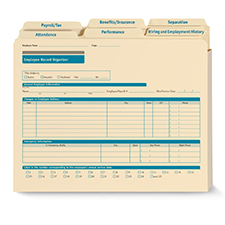
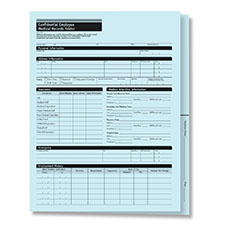
Confidential Employee Record
|  | « Back to Top
|  |  | We have a part-time employee who makes $8.00 an hour. She's going to start working full-time for two months to cover for someone going on leave, and we plan to boost her pay to $9.00. Can we return her to $8.00 an hour when she's back to part-time? |  |
 |  | There is no legal reason you can't boost, then reduce, this employee's pay. But first, a question: Will she be in a different role, with different or additional responsibilities?
If so, a temporary increase might be appropriate. In this case, document your intent and reasoning. Then meet with the employee and ask her to sign the memorandum to verify that: she understands that the increase will be temporary due to the additional roles or responsibilities, and
she understands that when the original role is resumed, her rate of pay will revert back to the regular rate.
If the employee is not taking on a different role or additional responsibilities, then why are you thinking about a temporary increase? If she is paid hourly, and you are increasing the number of hours worked by changing status to full-time, then she will be earning more money without the pay increase.
These products will help you deal with problems of this sort as they come up: State and Federal Employment Law Manual The Employer’s Legal Handbook Payroll/Status Change Form Fast Answers for People Managers: Time & Pay |  | « Back to Top
|  |  | Violence at Work: How do I deal with and document violence in the workplace? |  |
 |  | The best way to deal with on-the-job violence is through prevention.
First, understand that most workplace violence is perpetrated by non-employees, such as when an armed robber confronts retail help, the client of human services agency becomes physically abusive, or the spouse of one of your people comes after his or her mate at work. Your challenge is to keep your workforce as a whole safe. This might be best accomplished in consultation with an expert in security, who will propose specific methods like tall counters, pass cards, or secret security call buttons based on your circumstances.
It sounds, however, that your concern may be with employee-on-employee violence. Prevention is still the best approach. Here you have a number of options:
Make offers of employment contingent upon the results of a background check. This could screen out those candidates with a criminal history.
Have candidates take a pre-employment test that is designed to screen out people who could be a risk in your workplace.
Train supervisors to respond to employee concerns. When employees feel that the employer is not listening to them, frustration could turn to violence.
Have a policy that says the company won't tolerate workplace violence and any occurrence of violence at work is subject to disciplinary action, up to and including termination. If you have a progressive discipline policy, make sure it says that an employee may be terminated for the first occurrence of a serious infraction (like violence).
When workplace violence occurs, investigate and address the issue immediately. Document the investigation, employee and witness statements, the outcome, and how you reached your conclusion. If you decide not to terminate a violent employee, counsel him or her and document that as well.
Products that may put your mind at ease include:
Applicant Risk Profiler
Peace At Work |  | « Back to Top
|  |  | Do exempt employees have to turn in time sheets to the payroll department? How do exempt employees inform the payroll clerk of vacation and sick time taken? |  |
 |  | According to the Fair Labor Standards Act (FLSA), an employee must be paid on a salary basis to be considered “exempt” under the white-collar exemptions applicable to administrative, professional, or supervisory workers. This means that an exempt employee must receive his or her full salary for any workweek in which he or she performs any work without regard to the number of days or hours worked.
Exempt employees may keep time records for purposes of meeting requirements for allocating salaries and still not conflict with FLSA requirements, as long as these time records are not used as the basis for pay. Example: An employee's salary is drawn from the budget of two different departments, so it's important to know how to relate salary expense to one budget or the other. Tracking the hours for other reasons might destroy the exemption, making you liable for back overtime and taxes.
It is also important to make sure the employees you are treating as exempt truly meet the FLSA's criteria for exemptions. Moreover, some of the exemptions under the FLSA are only partial exemptions that require the employer to maintain time records even though the employees are exempt from minimum wage or overtime.
You should also implement a system by which your exempt employees can notify payroll of their time off, such as sick or vacation, so that this amount can be deducted from their paid-time-off bank. According to the U.S. Department of Labor, it is permissible to do this, as long as an employer has a bona fide vacation and sick-time policy and exempt employees otherwise receive their guaranteed salary.
G.Neil offers many products to assist with your time-tracking needs: Fast Answers for People Managers: Time & Pay FLSA Compliance Kit ComplyWare FLSA |  | « Back to Top
|  |  | Harassment: How do I deal with and document harassment in the workplace? |  |
 |  | Take a preventive stance. First step: Create a strong workplace harassment policy that states the company’s “zero tolerance” for harassment of any form - not just sexual harassment. This policy should include: 1) a definition of harassment; 2) examples of prohibited conduct; 3) the company's procedure for handling harassment complaints; 4) the responsibilities of those who are victims or witnesses to workplace harassment; 5) the role of managers in preventing and responding to harassment complaints; 6)an anti-retaliation statement.
Train managers and employees in the principles and practices of your policy separately. Why? Because each group has different responsibilities if harassment occurs. For example, managers need to be aware of the fact that the company could be held responsible for harassment that they commit, condone, tolerate, or fail to report, or for any acts of retaliation against employees who complain of harassment or participate in a harassment investigation. They can also be held personally liable under various legal theories for their actions if they engage in harassing behavior.
If you or anyone in the company becomes aware that harassment has occurred, start an investigation immediately or within forty-eight hours at the latest. Involve only those with a need to know, to ensure the confidentiality of all involved parties. Every step of the investigation should be thoroughly documented to protect the employer from legal claims. Follow up with the complainant and harasser as appropriate, and administer appropriate discipline.
There are many other considerations when faced with on-the-job harassment; the following products would therefore be extremely useful to you:
ComplyRight Harassment Prevention Kit
From Sex to Religion...And Everything In Between
Applicant Risk Profiler
Gradience Handbook Manager
Peace at Work Fast Answers for People Managers: Harassment |  | « Back to Top
|  |  | I need help in understanding my role as human resources supervisor when it comes to administering vacation time. Can you help? |  |
 |  | While you no doubt have a vacation policy that allows a certain number of days off based on time worked or years of service, administering time off can still be a touchy subject. That’s because vacation time should be approved based on business need. Companies must be able to maintain continuous and efficient service for customers and effective processing of the workload. If granting vacation at a specific time would present an undue hardship on the company (such as during a busy season or during the summer when others are likely to be absent), that time should be rescheduled for a later date that is convenient for both the employee and the company.
Your job, then, is partly that of arbiter or referee—who gets to take off vacation and when, and whose request takes precedence over another’s. The important thing is to have good reasons for your decisions and to treat everyone fairly and consistently based on objective criteria like seniority, rank, or dates the parties involved last took time off.
Note: Some employees like to take time off whenever they want. Make sure your vacation policy says time off is subject to supervisory approval. It should also say that an employee who uses vacation time without approval by his/her supervisor is subject to disciplinary action up to and including termination of employment. If employees take time off without approval, you may be able to consider them to have abandoned their positions—grounds for termination in some companies.
As with any policy, make sure you enforce it consistently—treating each situation arbitrarily can open you up to legal liability in no time.
These products will make it a lot easier to keep vacation time off from becoming a major headache:
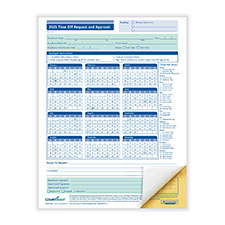
Vacation Request & Approval Records
Vacation Tracker
Gradience Handbook Manager |  | « Back to Top
|  |  | We have a part-time person who is starting to work full-time on a temporary basis. Is it legal to pay him one rate ($7.50/hour) from 8:00 a.m. to noon, and another rate ($8.50/hour) from 1:00 p.m. to 5:00 p.m.? |  |
 |  | Why are you doing this? An employer is certainly entitled to pay its people what it feels is fair and appropriate for services rendered, but having two different pay rates would create a lot of confusion on the part of both the employee and the employer.
Some things to consider before you institute this pay schedule:
Is the employee performing the same job in the morning as in the afternoon? If the job is the same, why pay at different rates?
What have you done in the past in a similar situation?
Is this person in a protected class (over forty, minority status, non-native, etc.)? If so, it may appear that you are discriminating against the person if there is no plausible explanation for the different rates.
If this person works in excess of forty hours per week, your payroll department would have to consider both pay rates in order to arrive at the correct regular rate before calculating overtime. For simpler administration, you might want to consider paying this employee $8.00/hour for all regular hours of work (making the overtime rate an even $12.00/hour).
Employers generally have the legal right to establish employees’ wage rates (assuming minimum wage and overtime requirements are met). However, it is important to have a legitimate basis for unusual wage arrangements, to document the basis for it, and to communicate the reasoning to the affected employee in order to avoid legal challenges and protect employee morale.
Here are some items that can help you reason through your HR challenges:
FLSA Wage and Hour Legal Guidebook
The Employer's Legal Handbook.
|  | « Back to Top
|  |  | What are the requirements for keeping employees’ I-9 records? |  |
 |  | Complete the I-9 form at the time you hire an employee. Employees have three business days from the date of hire to provide you with the documentation of identity and work authorization needed to complete Section 2 of the I-9 form. If, within that time, the employee produces a receipt showing that he or she has applied for a work authorization or identification document, you must give the employee ninety days to produce the required documentation.
You must accept documents listed on the Form I-9 Lists of Acceptable Documents in any of the combinations indicated on the form. Employees can choose which document(s) from the list they want to present.
Keep I-9 forms separate from employee personnel files. Doing so will help you avoid charges of discrimination, since the forms contain information like an employee’s age and national origin. It also allows for easier maintenance of the forms. Further, if the Immigration and Naturalization Service (INS) arrives for an audit, you can pull out I-9s easily and keep other sensitive information in personnel files private.
Use a binder system for storing of I-9 forms. Keep two large three-ring binders, one for current employee I-9 forms and one for terminated employee I-9 forms. When you hire a new employee, place the I-9 form in the current employee binder. When you terminate an employee or one otherwise departs, transfer the I-9 form into the terminated employee binder. Note the date of termination in the margin of the I-9 form.
Last, periodically review the current I-9 forms in order to identify employees for whom you will need to reverify work eligibility. Review the forms of terminated employees to determine which may be discarded. (You must retain I-9s for the duration of an employee’s employment, plus one year, or for a minimum of three years from the date of hire, whichever is longer.)
ComplyRight I-9 RecordKeeping Kit
|  | « Back to Top
|  |  | How long must I retain records for former employees? |  |
 |  | The retention period for various employee records varies based on the various employment laws you are subject to: Here are some guidelines, but keep in mind that your state may impose additional requirements:
Age Discrimination in Employment Act (ADEA)
Payroll records: 4 years for tips and total wages.
Screening tests: 1 year for employers with 100 or fewer employees.
Drug test results: 1 year after action taken.
Result of physical exams: 1 year.
Hiring, promotion, demotion, transfer, selection for training, layoff, recall or discharge of any employee: 1 year after action taken. Employee records including name, address, date of birth, occupation, rate of pay, compensation per week: 3 years. Records of charges of discrimination and any personnel records relevant to a pending charge: until final disposition. Benefit plans: at least 1 year after termination of the plan.
Equal Employment Opportunity Commission (EEOC) Request for reasonable accommodation: 1 year after the record made or 1 year after action taken, whichever is later. Hiring, promotion, demotion, transfer, selection for training, layoff, recall or discharge of any employee: 1 year after record made or 1 year after action is taken, whichever is later. Termination records: 1 year from termination date.
Employee polygraph Protection Act (EPPA) Polygraph test: 3 years from the date the polygraph test is conducted.
Employee Retirement Income Security Act (ERISA) Benefit plans: 6 years.
Federal Insurance Contribution Act (FICA) Payroll records: 4 years for occupation, rate of pay compensation earned by each employee.
Fair labor Standards Act (FLSA) Child labor: verification of age for minors, 3 years. Employment contracts: 3 years. Payroll records: 4 years (includes payroll records, certificates, collective bargaining agreements, contracts, plans, trust) Employee evaluations, seniority systems, wage rates, merit systems, collective bargaining agreements: 3 years.
Family and Medical Leave Act (FMLA) FMLA documentation: 3 years after leave ends.
Immigration Reform and Control Act (IRCA) I-9 forms and additional verification information: the later of 3 years from date of hire or 1 year after termination.
Occupational Safety and Health Act (OSHA) OSHA forms related to injuries and illnesses: employers with 10 or more employees must keep these records 5 years following the end of the year to which they relate. Medical exams and records related to or indicating employee exposure to toxic substances or otherwise harmful physical agents: 30 years after termination of employment. Records concerning measurement of employee noise exposure: 2 years.
As you can see, one type of document may be covered by numerous, conflicting retention requirements. That's why you should keep records as per the lengthiest requirement. For example, since payroll records are required to be kept for 3 years under the ADA, and 4 years under FICA, retain then for 4 years.
G.Neil offers many excellent resources to assist you with organization of your personnel files and in meeting your retention requirements. here are a few favorites: Employee Record Organizer Confidential Employee Medical Records Folder Personnel Pocket File Folder Employer’s Guide To Recordkeeping Requirements State and Federal Employment Law Manual Easy Reference: Employee Record Retention |  | « Back to Top
|  |  | I need help in understanding my role as human resources supervisor when it comes to documenting discipline and terminating employees. Can you help? |  |
 |  | Since managers/supervisors work closest with their employees, they are - or should be - the ones handling the disciplinary process in most cases. They are also generally responsible for deciding to terminate and employee, thought in situations like a mass layoff, you may be called in to do the job.
Whatever the case, HR has an important job: ensuring that supervisors are coaching and counseling employees properly, as well as documenting performance issues before they terminate. While some managers like to get rid of poorly performing employees immediately, it is good business practice to first put them on a performance-improvement plan to assist them in meeting the company's expectations.
HR must also ensure that all disciplinary and dismissal procedures are handled consistently and "by the book," based on the company's stated disciplinary and termination policies. To do otherwise is to invite legal problems.
In most companies, the standard termination practice is for the immediate supervisor to do the firing. The task should be done in person and in a private location. If the person being terminated is a "hard case," or if you think a legal challenge might result, it is often useful to have a third person present. As often as not, that would be you, the HR person.
You should also ensure that any manager terminating an employee discusses issues such as final paycheck arrangements and benefits information, retrieves company-owned equipment, and communicates information about outplacement or other help during the period of joblessness.
Every company, however, handles things differently. In some, HR handles all discipline and firings. Perhaps you can meet with your supervisor to discuss and clarify your role and responsibilities. Once you are clear as to the role HR plays in your organization, you can feel more confident in communicating ways you can help others in the management team. This will ensure they keep you in "the loop" in the future.
Here are few resources that outline your responsibilities in greater detail and help you carry them out:
The Employer's Legal Handbook
Discipline and Termination
Counseling Report
Performance Improvement Plan
Employee Warning Notice
Separation Notice
Checklist for Employee Separation Fast Answers for People Managers: Performance |  | « Back to Top
|  |  | We would like to adopt a travel policy that pays employees for all hours traveled in the course of the normal work day and then pays for hours traveled outside of the normal work day at the employee's regular hourly rate (not overtime). Is this legal?
|  |
 |  | While not all travel time should be considered hours worked, any travel time that would count as hours worked per the Fair Labor Standards Act (FLSA), should also count towards overtime. Non-exempt employees may not work for more that forty hours in a week without receiving a least one and one-half times their regular rates of pay for the overtime hours. The principles that determine whether time spent in travel is compensable time depends upon the kind of travel involved:
Home-to-work travel: An employee who travels from home before the regular work day and returns to his/her home at the end of the work day is engaged in ordinary home-to-work travel. This is not work time.
Home-to-work on a special one-day assignment in another city: Suppose an employee who regularly works at a fixed location in one city is given a special one-day assignment in another city, and then returns home that same day. The time spent traveling to and returning from the other city is work time, except that the employer may deduct/not count that time the employee would normally spend commuting to the regular work site.
Travel that is all in the day's work: Time spent by an employee in transit as part of his/her principal activity (e.g., traveling from job site to job site during the work day), is work time and must be counted as hours worked.
Travel away from home community: Travel that keeps an employee away from home overnight is travel away from home. Travel away from home is clearly work time when it cuts across the employee's work day. The time is not only hours worked on regular working days during normal working hours but also during corresponding hours on non-working days. As a general rule, work time spent in travel away from home outside of regular working hours (e.g., as a passenger on an airplane, train, boat, bus, or automobile) is not considered hours worked unless actual work is being performed during travel (e.g. working on computer presentation while traveling in airplane).
To answer questions of this nature in the future, you may wish to have the following books close at hand:
FLSA Wage and Hour Legal Guidebook
State and Federal Employment Law Manual. |  | « Back to Top
|  |  | How long must we keep applications or resumes from job applicants? Also if someone just mails in or drops off a resume, are we required to keep it on file? |  | « Back to Top
|  |  | We are planning to ask that all new hires undergo a physical examination. What questions can we put on the physical form? We do not want to run into trouble with ADA. |  |
 |  | The Americans with Disabilities Act (ADA) permits physical examinations under fairly limited circumstances. A physical examination may not be used to pre-screen applicants for employment. Physical examinations are allowed only after a conditional offer of employment has been made. The offer of employment may be contingent upon passing the physical. However, if a conditional offer is withdrawn, you immediately raise questions about whether or not reasonable accommodations were possible.
If you conduct physicals after extending a conditional offer of employment, the physical should measure only qualities that are related to the job to be performed. It should be administered in the same manner for all candidates that will be hired for the same job position.
As for the form used by the physician to evaluate the employee, it should likewise address only health issues that relate to the job. You should therefore provide the physician with the form to use. If the job is a desk job, for instance, there is probably no need for the physician to evaluate physical strength, so the form should not ask for that info. If you use only one form for a variety of positions (and you probably shouldn't), cross out the items that do not relate to the job and make sure you use the same amended form for everyone.
A pre-employment drug screen is not considered to be a "physical examination," and is therefore permissible under the Act. Once the hurdle of a conditional offer and a pre-placement physical examination are cleared, you may conduct examinations required by other laws (Department of Transportation physicals, OSHA or MSHA tests, etc.) and offer voluntary wellness programs. You are restricted in requiring your employees to undergo additional physical examinations, however, to those which are job-related and consistent with business necessity.
A physical examination is job-related and consistent with business necessity when an employee: Is having difficulty performing his/her job effectively; Becomes disabled; or Requests an accommodation on the basis of a disability.
Other products to help you handle ADA issues include: Confidential Employee Medical Records Folder Substance Testing Consent Form |  | « Back to Top
|  |  | Do you have a sample “thank you” letter to mail to applicants that have sent their resumes in to our company for review? |  |
 |  | Here’s an idea that assumes you haven’t filled the position; adapt it for your own needs.
Thanks for your interest in working for [Company name]. The manager in charge of filling the position you applied for is still considering the many applications that have come in. If we decide we’d like to learn more about you and your experience, we’ll be in touch to set up an interview.
The following is for those whom you’ve decided not to hire:
Thanks for your interest in working for [Company name]. Unfortunately, we have hired someone else for the position. Thank you again for thinking of us, and best of luck in your job search.
|  | « Back to Top
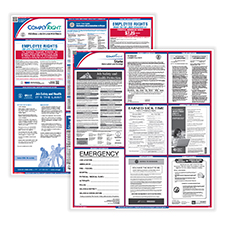
|  |  | We have stores across the country. Do you have a labor law posting compliance checklist for each state? |  | « Back to Top
|  |  | Our handbook states that that we give a yearly review and compensation review on the first anniversary of an employee’s tenure with the company, and then every October after that. We hired an employee on August 5. Should she receive a review and raise in August and then get reviewed again in October and receive another pay increase? |  |
 |  | You have two options here:
1) You can revise your policy so that all employees receive their first review in October. Employees who have not been with the company for a full year would receive a prorated increase, based on their performance rating and length of service. For example, an employee with six months of service prior to October would receive one half of a full year’s increase. Going forward, he or she would continue to receive annual reviews (with full-year increases) in October.
2) You could follow your current policy and wait until next August to give your new employee an annual performance and salary review. The following October, you could give her a prorated increase, based on the amount of time that has passed between the August increase and the regular company cycle in October. Going forward, she would continue to receive annual reviews (with full-year increases) in October.
The first choice seems a little easier administratively, since all employees would always be on the October schedule.
Appraisals can be a valuable way to improve your organizational results. Make them even more powerful by taking a look at some of these products:
Introductory Performance Appraisal Form
Performance Appraisal Form
Effective Phrases For Performance Appraisals
Powerful Performance Appraisals
State and Federal Employment Law Manual Fast Answers for people Managers: Performance Gradience Handbook Manager |  | « Back to Top
|  |  | Are the I-9 and W-4 forms supposed to be kept in a common location? We have two different payrolls at our company and one of the supervisors thinks she is the only one allowed to keep certain files on her employees. I think the human resources representative should keep all employee files in one common location. Who is right? |  |
 |  | The human resources department is customarily the “keeper” of the files. There is no law that states that an employee’s entire file must be kept in one location, and there is no law stating that the file cannot be kept in one central location. However, it is usually easier, administratively, to keep an employee’s personnel file in one place. That way, you can find an employee’s complete history with the company easily, and there is less risk of losing important documentation.
W-4s can be kept with an employee’s file but can also be kept in a separate payroll file, in the payroll department, if need be. The W-4 form is kept by the company, and is sent to the Internal Revenue Service only if employees claim that they are exempt from income tax withholding or if they claim ten or more exemptions.
Although not required by law, it is best practice to keep your I-9 forms separate from employee personnel files. Since the forms contain information on age and national origin, keeping them separate enables your company to avoid charges of discrimination. In addition, keeping I-9 forms separate from personnel files makes it easier to produce them for an internal or INS audit. If you need to produce the forms for an INS audit, it also eliminates the possibility the INS will become privy to sensitive information in other parts of the file. Whoever is responsible for verifying, re-verifying, and purging I-9s should have them easily accessible.
Other products you might find useful include:
ComplyRight I-9 RecordKeeping Kit
Employer's Guide To Recordkeeping Requirements
I-9 Compliance Kit
State and Federal Employment Law Manual
Personnel Pocket File Folder Easy Reference-Employee Record Retention
|  | « Back to Top
|
|
|
| |
|